 Max's PPPP
P4 Primary Research
Two of the most important parameters when it comes to the sound signature of reverb are room size and decay. I began my primary research into the physics of reverb using the most convenient thing I had—my own room!
To emulate my room, there are many variables to consider. Since reverb is the sound of room reflections, a larger room will give delayed early reflections. These delayed early reflections will overall give the reverb a slower attack and a less metallic sound. The speed of sound is 343 m/s, so the first reflection would occur at 2*L / (343 m/s), where L is the closest wall in meters. For example, if the closest wall is 5 meters away, then the first reflection should occur 29 ms after the source signal. I will be measuring fairly close to the nearest wall, about 1.7 meters away, giving a first reflection about 5 ms after the source signal.
Decay is the time required for reflections to become inaudible. Reverb is typically considered inaudible once the drop in sound pressure level (SPL) reaches 60 dB. The reverberation time, or RP60, has an empirically measured formula: RP60 = 0.163 * V / A, where V is the volume of the room in cubic meters and A is the absorbing area of the room in square meters. The absorbing area depends on the room’s materials and furniture. My bedroom is approximately 4 m by 3.6 m by 2.4 m, with one door approximately 1.5 square meters.
The effective absorbing area would be 36.4 m^2 (wall area) * 0.05 (wall coefficient) + 14.4 m^2 (ceiling area) * 0.05 (ceiling coefficient) + 14.4 m^2 (floor area) * 0.15 (floor coefficient) + 1.5 m^2 (door area) * 0.05 (door coefficient) = 4.78 m^2. RP60 would be 0.163 s/m * (4 m * 3.6 m * 2.4 m) / 4.78 m^2 = 1.18 s.
The ideal decay time in music is usually between 0.5 seconds and 2 seconds, but it can vary greatly. A shorter decay time is preferred for communication and speech. However, a longer decay time may be used to create a music hall effect.
To recreate the reverb response of my room, I’ve taken impulse responses and sampled audio at various distances. The final video will feature these audio clips and example reverb techniques.
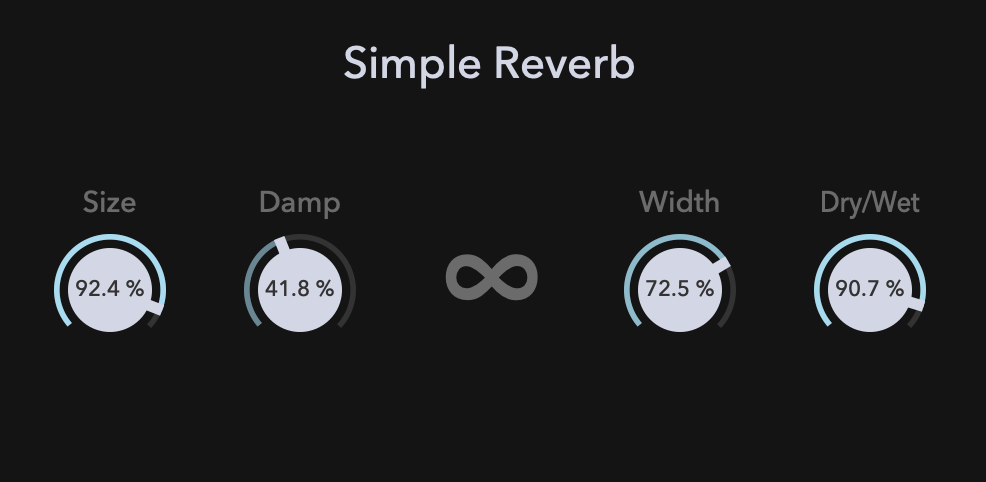
Furthermore, I’ve been experimenting with JUCE, which has a 2D rendering engine and strong support for DSP and audio technology. Digital audio plugins can be made in JUCE, including some great sounding reverbs. SimpleReverb is a great open-source reverb plugin made in JUCE:
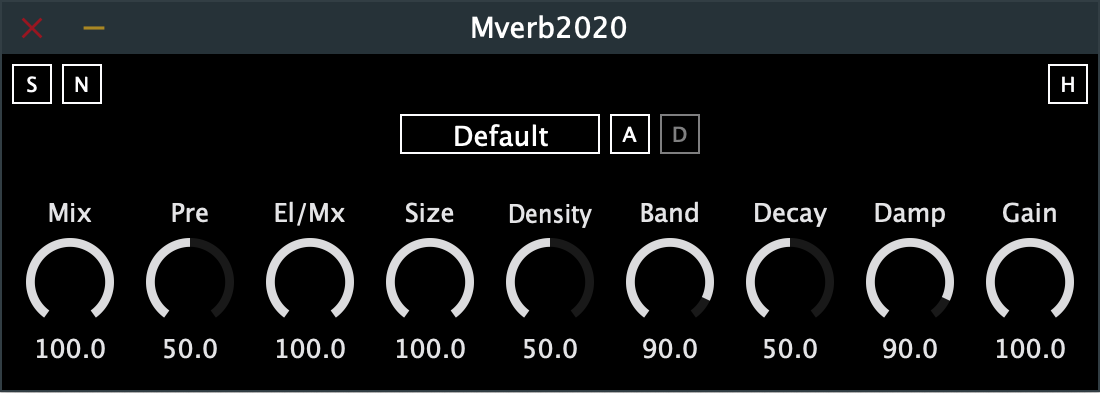
And as stated previously, MVerb and Dragonfly are both great open-source reverbs to analyse.
More details to come in the video!