 Max's PPPP
P4 Brainstorming
It’s time for physics! Woo!
The first idea I had for my physics project was to do something audio-related. In my free time, I like to produce electronic music. My favourite synthesis technique is additive synthesis, and I’m excited to explore further. I’ve also enjoyed toying with effects like reverb and delay. Lastly, I’ve run into issues with phase and DC offset. I wonder what physics has to do with all of these?
Additive Synthesis
In 1807, Joseph Fourier proved that any waveform could be decomposed into a series of sine waves. This is the basis of additive synthesis, a process generating timbre through the composition of sine waves. The following diagram shows how a square wave can be created through the summation of sine waves with higher and higher frequencies. These higher frequencies, or harmonics, give the waveform timbre.
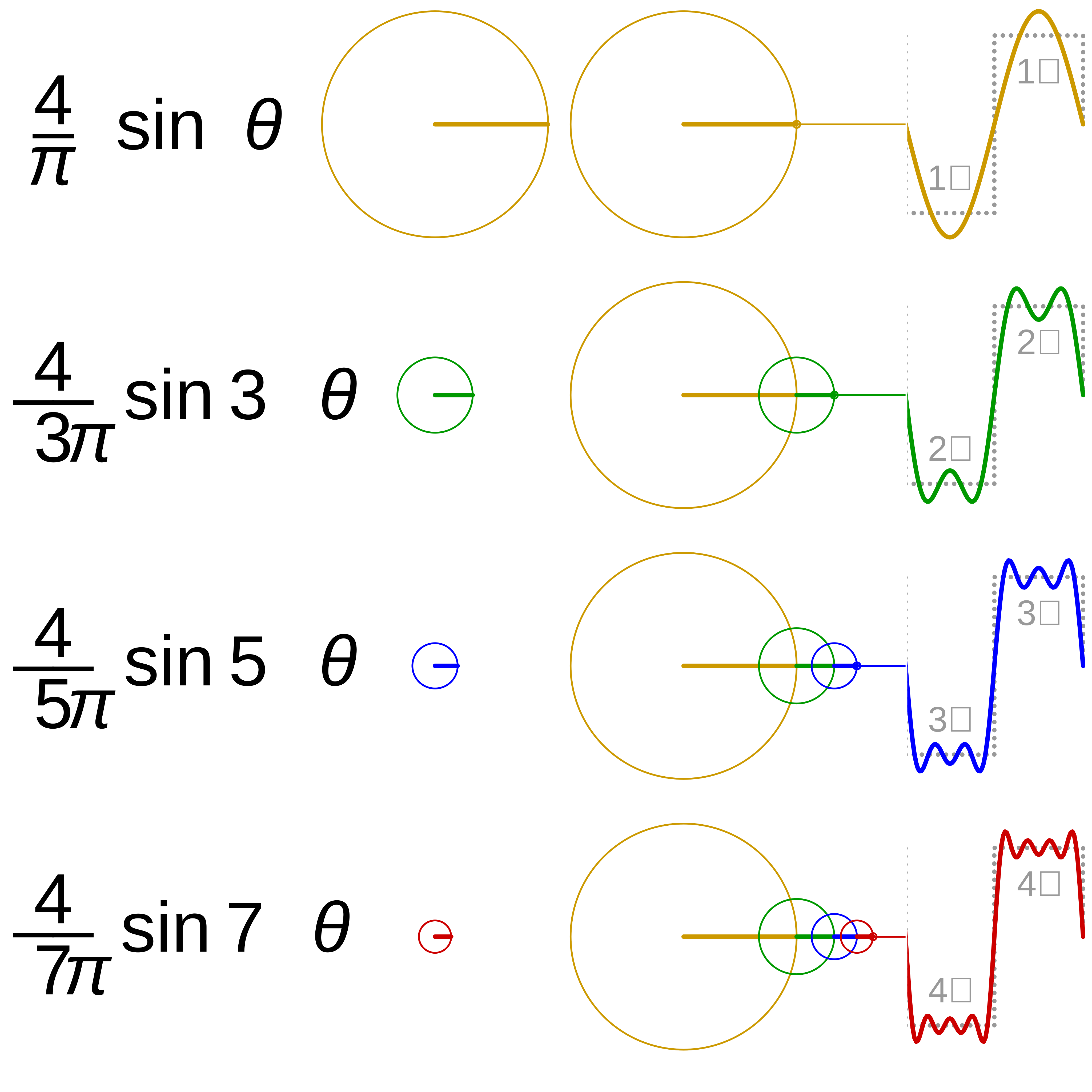
Diagram from Wikipedia.
One of my favourite plugins is Harmor, an additive synthesizer released by Image-Line in 2011. It’s powerful because effects can be applied to each individual sine wave. Many other synths use subtractive synthesis, meaning they start with a harmonically rich waveform like a saw wave and then filter out harmonics. This is arguably more intuitive, but less powerful.
I don’t know what a related physics project would be, though. I could code a synthesizer using C++ and JUCE, but that would be more of a programming and mathematics exercise than anything else. Wave physics would be used, but more research will be necessary to determine whether this is a suitable approach. Another idea would be to create a spectrogram generator. A spectrogram is a visual representation of signal frequencies, sometimes used in music and phonetics studies. This would also require knowledge of wave physics and Fourier transforms.
Plate Reverb
Reverberation, or reverb, is what you hear when sound is reflected off the environment. A series of echoes is produced, continuing long after the original sound has stopped. Reverb is dependent on the properties of the room. For example, a large space will produce a longer reverb, whereas a small space will produce a short reverb.
The reverbs I use in music production are digital, which often create the effect by layering delays and filtering the sound. Convolutional reverb is another common approach. It produces its sound through a sample of a real-world space. Both of these approaches are great, but nothing I haven’t used before.
So it’d be an exciting project to build a mechanical reverb! Plate reverb was designed as a cheap alternative to acoustic reverbs, which required large physical spaces. Plate reverb imitates the sound of a room using a thin metal sheet, or a “plate”. The plate is vibrated, and a contact microphone captures the sound. The result is a warm, lush reverb that has bright and powerful early reflections. I typically use it for brighter sounds, but the decay quickly becomes bassier and dark. Plate reverb is all over classic albums, being used by Pink Floyd and The Beatles.
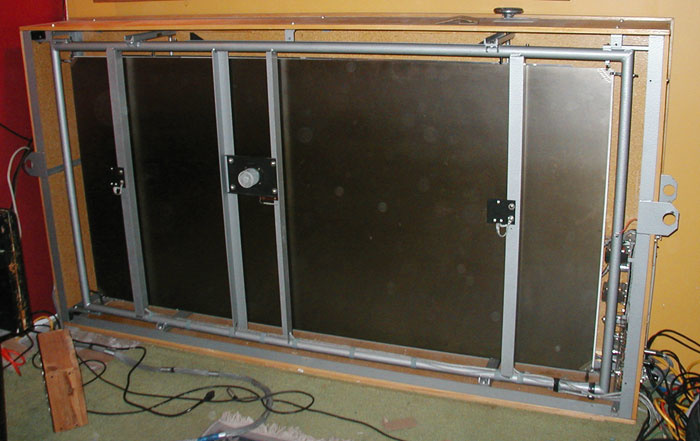
The metal sheet, or “plate”, is vibrated to create reverberation.
Building a physical plate reverb poses several challenges. For one, the “plate” is fairly large! It’s often around 6 feet long by 4 feet wide. Building a smaller plate reverb is unfeasible, since the resonant frequencies would be much higher. I’ll probably have to keep it in my basement. Gathering the materials would also be somewhat difficult, with an estimated construction cost of $100-$500.
Phase Issues
Wave interference is something every musician will run across, especially when recording audio. One of the shocking-yet-obvious discoveries of physics is that two signals that sound the exact same can cancel each other out entirely. When recording an instrument with multiple microphones, or using multitrack recording, destructive interference can occur. If two signals are the exact same, but are 180 degrees out of phase, they will cancel out entirely. Even just a bit of phase cancellation can be detrimental to a song!

Left: Constructive interference. Right: Destructive interference.
This is easy enough to understand, but many projects involving phase interference are fairly difficult, as it would require actively capturing and then outputting sound that is exactly out of phase. As such, actively phase cancelling anything more complicated than a sine wave might be difficult. One common use of phase cancellation in consumer products is in active noise-cancelling headphones. Active noise-cancellation works by recording environmental audio and quickly generating its phase inverse. I don’t know what the effects of latency are specifically, but any delay would be massively less effective.
These three ideas are all excellent, but all pose their own challenges. In the coming week I’ll solidify a plan and begin work on the project!